A Close Look at Opening Credits on a Rainy Afternoon
Use a rainy afternoon to read opening credits closely and notice how names, type, and images quietly prepare you for the film ahead.
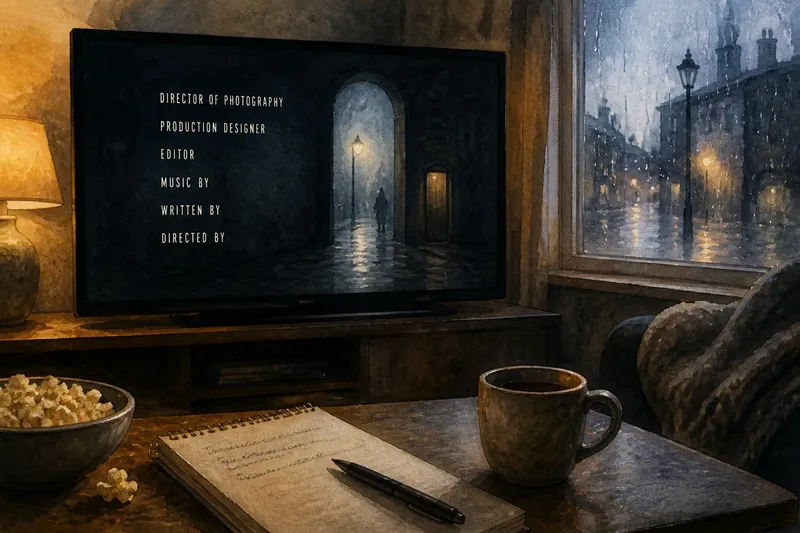
Opening credits reward a different kind of attention than the story that follows. On a rainy afternoon, choose a film you have not seen, settle somewhere comfortable, and watch the first few minutes without reaching for your phone. This opening-credits viewing exercise turns names, typography, and images into clues about the film’s mood and priorities—not a puzzle with one correct answer.
Think of the credits as a small sequence with its own rhythm. A name may appear over a face, a landscape, a blank field, or an image that seems unrelated. The order and design can shape what you expect before the plot has properly begun. Your job is simply to notice what arrives, when it arrives, and what it makes you anticipate.
What should you set up before the credits begin?
Pick a feature with a distinct opening-credit sequence. A film with a few quiet cards can be just as revealing as one that layers titles over moving images. If the credits are brief, watch them twice: first without pausing, then again with a notebook nearby.
Keep the setup plain. Use the screen you normally watch films on, dim the room if that helps you focus, and have a pen and paper ready. Avoid searching for the cast list or reading a synopsis first. Knowing the plot can make every visual detail feel like a clue, even when it is simply part of the film’s design.
Before pressing play, write down a few expectations. Does the title make you anticipate a comedy, a mystery, a romance, or something harder to classify? Note your first impression, not a polished interpretation. Later, you can compare it with what the credits actually suggested.
How do you follow the sequence without overthinking it?
Watch once straight through. Let the music, silence, image changes, and names pass at their natural pace. When the first scene begins, jot down only a handful of words: perhaps “formal,” “uneasy,” “playful,” or “distant.” A rough response is more useful here than a detailed theory.
On the second viewing, follow the order of names. Notice who appears before the title, who comes after it, and whether the sequence gives special emphasis to a particular role. Do not assume that screen order reveals a simple ranking. Instead, ask what the arrangement makes prominent: a performer, a filmmaker, a production company, or the film’s own name.
Then track the title itself. Does it arrive early, after a visual buildup, or near the start of the story? Is it placed over an image, set against a plain background, or woven into the scene? Its timing can feel like a threshold: the film may appear to announce itself before the action, or let the audience enter the world first.
Use pauses sparingly. Stop only when a card, transition, or image catches your attention, and record what you saw before explaining what it means. That small distinction keeps observation separate from interpretation. “A name appears in narrow white letters over a dark doorway” is something you can point to; “the film is about secrets” is a possibility to test as you watch.
What can type and placement tell you?
Look at the lettering as an image, not just as a container for names. Is it clean and restrained, ornate, hand-drawn, tightly spaced, or unusually large? Does it sit still, slide into view, or seem to belong to the setting? These choices affect the sequence’s character before any plot information arrives.
Compare the typography with the images behind it. Crisp letters over a busy scene may feel deliberately at odds with the background. A title that blends into a wall, sign, or other visible surface can make the credits feel embedded in the film’s world. Neither approach has a fixed meaning; the useful question is how the contrast or fit changes your attention.
Notice legibility, too. If a name is difficult to read, ask whether that seems incidental or part of a deliberate visual texture. You do not need to judge the design as good or bad. Record whether the lettering invites you to pause, glance quickly, or keep watching the moving image instead.
Why watch the images as well as the names?
Credits may show objects, places, faces, abstract shapes, or fragments of action. Treat each as an introduction to the film’s visual vocabulary. A repeated color, a particular kind of framing, or a familiar object can establish a pattern that the story later develops—or simply set a mood without announcing a plot point.
Pay attention to what the sequence withholds. A film might show a landscape but not identify it, or give you a close view of an object before its purpose is clear. That gap can create curiosity. Write down the question it raises, then see whether the film answers it or leaves the image as atmosphere.
Sound matters even when your focus is visual. Music can make an ordinary image feel tender, comic, or ominous; silence can make a title card feel stark. Notice where sound begins and whether it changes with a new name or image. You are not trying to separate the soundtrack from the visuals, but to see how they guide your first impressions together.
What questions help you read opening credits?
Do opening credits reveal the film’s genre?
They can suggest a genre through music, lettering, pacing, or familiar imagery, but a suggestion is not a promise. Note what you expect, then stay open to the film complicating that expectation.
Should I pause to read every name?
Pause if a name or role interests you, but do not turn the viewing into a roll call. The sequence’s movement and grouping often matter more to this exercise than memorizing every credit.
What if the credits appear over the first scene?
Follow both layers: read what you can, then watch how the scene develops beneath the words. If one competes with the other, note which one drew your attention and whether that changed as the sequence continued.
Can I do this with a film I already know?
Yes, though familiarity may make you connect images to later events quickly. Try a first pass focused only on form, then watch again to see how your knowledge reshapes the opening.
How can you spend the rest of a rainy afternoon?
Give the exercise a gentle shape rather than turning it into homework. Watch one film’s credits once without notes, then watch them again with your notebook. After the second pass, view the opening scene and see which expectations held up. Take a short break before writing a few lines about the sequence’s order, type, images, and sound.
Say you choose an unfamiliar mystery that begins with pale lettering over a quiet train platform. On the first pass, you write “still, watchful.” On the second, you notice the title appears only after several names, while the camera remains fixed on an empty bench. Your note might be that the sequence delays the film’s name and makes the empty space feel worth watching. The useful result is a clearer account of what the credits led you to expect, not a claim that you have solved the film.
If you want to compare, choose a second film with a noticeably different opening style. Keep the comparison narrow: perhaps one uses a plain title card while the other places names over action. Ask how each directs your attention and what kind of entry into the story it offers. You do not need a stack of films or a spreadsheet to see the contrast.
What is not worth the effort? Trying to decode every color or font as if it had a universal meaning. A red title may feel urgent in one sequence and decorative in another. Describe what it does in that particular opening before reaching for a larger explanation.
Close your notes with one question you would carry into the film: What detail in the credits do I expect to matter later? Keep the question in mind, but do not hunt for confirmation. Opening credits are a first encounter, and their craft is often most visible when you let the film surprise you. For a relaxed opening-credits viewing exercise, that balance—careful attention without forced answers—is enough to make the next rainy afternoon feel newly watchable.