When the Camera Learned to Move: The Early Language of the Tracking Shot
The early tracking shot turns camera movement into story: learn to distinguish a moving viewpoint from action inside the frame and read its purpose.
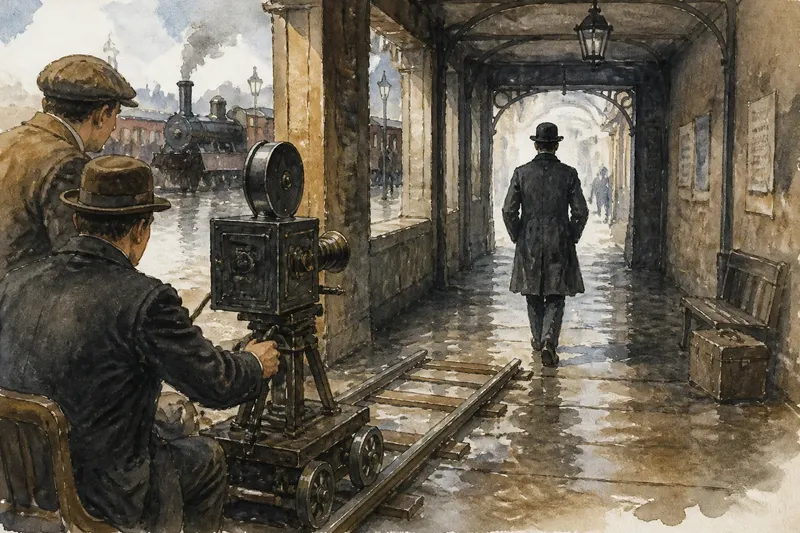
In an early film, a figure can cross a room while the camera stays planted—or the camera can travel with the figure, carrying the room past us. That difference is the heart of the tracking shot: the viewpoint itself moves, making the audience feel that it has entered the scene rather than simply watched it. The early tracking shot became a storytelling choice when filmmakers began using that movement to shape attention, space, and feeling.
What moves in an early tracking shot?
Start by watching the background, not the actor. If a performer walks across a fixed frame, the doorway, furniture, and walls hold their positions. If the camera tracks alongside the performer, those surroundings slide or shift in relation to the subject. The actor may remain near the same place on screen while the world seems to glide past.
“Tracking shot” is often used broadly for a camera move across space. A dolly move travels on a wheeled platform or other support; a lateral track follows a path sideways, while a forward move approaches a subject. Early films used a variety of practical arrangements, so the visible effect matters more than guessing the exact equipment. A moving viewpoint is the defining feature.
Motion within the frame is different. A horse galloping toward the camera, a train passing behind a stationary figure, or a crowd crossing a plaza can make an image feel energetic without moving the camera. This distinction is easy to lose in a busy scene. Pick a fixed feature—a window frame or street corner—and see whether it changes position relative to the edge of the image.
Why move the viewpoint instead of the actors?
A tracking shot can make a location feel continuous. Rather than cutting from one view to another, the camera carries us through a doorway, down a corridor, or beside a vehicle. The movement lets the audience gather details in sequence: a room opens up, a person appears, then an obstacle comes into view.
It can also shift allegiance. A camera following one person encourages us to share that person’s route, even when the scene contains other activity. If it leaves the person behind to continue into an empty passage, the space itself becomes the subject. Neither choice needs dialogue to be legible; the direction and pace of the movement offer clues.
In early cinema, a moving camera could also make an attraction of the view. A ride through a landscape or along a city street gives spectators a traveling position they could not easily occupy themselves. That spectacle does not cancel story. A journey can establish where characters are headed, contrast crowded and quiet places, or prepare the eye for an arrival.
How can you read the movement on screen?
Try a simple viewing routine. Choose one person and one stable background feature, then follow each separately. Notice whether the person stays centered, drifts toward an edge, or disappears; note what the camera reveals before and after. Those choices can tell you whether the move accompanies, pursues, observes, or abandons its subject.
- Follow: The camera keeps pace with a walking figure, preserving a steady relationship between person and frame.
- Approach: The subject grows larger as the camera advances, making a face, doorway, or object claim more attention.
- Reveal: The camera passes an obstruction or rounds a corner, bringing new space into view.
- Leave: The camera continues after a person exits, asking us to inspect the place they have vacated.
Say you encounter an invented scene in which a character leaves a station platform and enters a covered passage. The camera follows at walking pace, then keeps moving after the character turns out of sight. You can reasonably read the first stretch as shared travel and the ending as a shift toward the passage’s uneasy emptiness; the observable clue is that the camera’s attention outlasts the character’s presence.
It is not worth trying to identify every hidden rig from a few seconds of footage. A fixed vehicle, a platform, or a camera mounted on a moving conveyance may produce similar screen effects. Unless the production method is the subject, spend your attention on what the move makes visible and how it changes your relation to the scene.
What questions help identify an early tracking shot?
Does a pan count as a tracking shot?
A pan turns the camera from a fixed position, changing the direction of the view without carrying the camera across the scene. A tracking shot changes the camera’s position in space, so nearby and distant objects can shift differently against one another.
Can a camera move without following a character?
Yes. It may explore a room, reveal a landscape, or travel along a street with no single person as its guide. Watch what the movement selects and what it leaves behind; that choice still shapes the scene’s emphasis.
How can I tell camera movement from movement inside the frame?
Compare a subject with a stable background feature. When only the subject moves, fixed architecture stays put; when the camera travels, the relationship between the subject and background changes across the image.
Why might an early film use a moving viewpoint?
Movement can connect spaces, share a character’s journey, or turn a place into a visual event. The purpose depends on where the camera goes, how long it stays with its subject, and what it shows next.
What should you notice on a second viewing?
Replay the shot with its ending in mind. Does the camera stop with the character, arrive before them, or continue into a space they have left? Then look at the opening: a move that begins on a crowded street and ends at a private doorway creates a different impression from one that starts indoors and pushes toward the street.
These small observations make the early tracking shot easier to read without treating every glide as a technical novelty. Its language lies in the relationship between the moving viewpoint and the world it passes through. When you watch for that relationship, the camera’s path becomes part of the action—not just a way of showing it.