Silent Film Intertitles or Spoken Dialogue: Two Ways to Carry a Story
Compare silent film intertitles and spoken dialogue to see how each carries story information, controls pace, and gives viewers room to infer meaning.
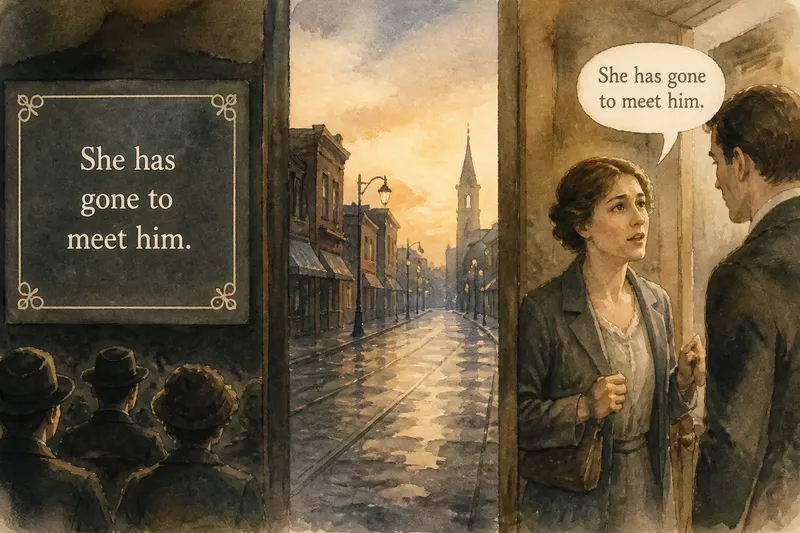
A character leaves a room, and the next shot shows an empty street. In one film, a card announces, “She has gone to meet him.” In another, the character says the same thing aloud before leaving. Both versions convey the plot, but they ask the audience to watch differently. Silent film intertitles and spoken dialogue are not just alternate containers for words: each changes the timing, emphasis, and amount a viewer must infer.
If a scene feels oddly slow, confusing, or over-explained, the trouble may lie in how it carries information. Looking at the differences can help explain why a card interrupts one scene effectively while spoken words might flatten another, and why a quiet look can sometimes do more than either.
Why does an intertitle feel like an interruption?
An intertitle temporarily replaces the moving image with written language. That break can feel abrupt, especially when a card explains something the audience already understands from a gesture or a change in setting. The cause is often not the mere presence of text, but its timing and workload: the card stops the scene to deliver information that could have been shown, inferred, or omitted.
Try asking what the audience would know without the card. If a character points to a train ticket, grabs a coat, and hurries toward the station, a title saying “I must catch the train” may repeat the image. If the destination or motive matters and cannot be made clear visually, the card earns its place.
Intertitles also create a distinct rhythm. The viewer reads, then returns to the image, often carrying the sentence into the next shot. A concise card can sharpen suspense: “The door was already open.” A longer paragraph may slow the scene for a reason, such as establishing a letter’s contents, but it can also make a tense moment feel like a reading assignment. When the card stalls the action, try shortening it or placing it where the image can hold attention while the audience absorbs the information.
Why does spoken dialogue sometimes explain too much?
Dialogue keeps the image moving while characters talk. That can make a scene feel continuous, but speech can also crowd out visual clues. If a character says, “I’m afraid you’ll leave me,” while clinging to a suitcase and watching the other person reach for the door, the words may name an emotion the action already makes plain.
The cause is often a mismatch between what the audience can see and what the scene insists on saying. Dialogue is useful for a concealed motive, a decision, or a difference in what characters know. It is less useful when it merely captions a visible action. To diagnose the problem, imagine muting the exchange. If the scene still communicates the same emotional turn, consider trimming the repeated lines. If the meaning disappears, the words may be carrying information the image cannot supply.
Speech also gives information a human source. A warning from a nervous friend can reveal the speaker’s judgment as well as the danger. An intertitle stating “The bridge is unsafe” reports the fact without that personal coloring. Neither form is automatically more expressive; the choice depends on whether the story needs a voice, a statement, or room for uncertainty.
What causes the pace to drag or rush?
Intertitles make the pause visible. Each card marks a transition between watching and reading, so a run of cards can make the story feel measured or stop-start. Spoken dialogue can hide those pauses inside a continuous scene, but a lengthy exchange may still slow the action. The relevant question is not simply how many words appear. It is whether each beat changes what the audience knows, expects, or feels.
If a sequence drags, identify where the story’s forward motion stops. A card may restate an earlier point; a line of dialogue may answer a question the scene has not yet made interesting. Try removing that repeated beat in your interpretation of the scene and see whether the next action still makes sense. If it does, the information may not need another delivery.
If a sequence rushes, look for a missing interval. A card such as “Three days later” can bridge a gap cleanly, while dialogue can let a character explain what happened during it. But sometimes neither is needed: a changed costume, a different light, or a new location may signal the passage of time. The form that works best is the one that gives the audience enough orientation without making them wait through an unnecessary explanation.
Why does a scene leave viewers unsure what to infer?
Ambiguity can be deliberate, but accidental confusion often comes from withholding a necessary connection. An intertitle may state a fact without showing why it matters. Dialogue may hint at a secret without giving the audience enough context to recognize the hint. In either case, viewers need some clue to connect the information to the action.
Try separating the scene’s facts from its interpretation. The audience might need to know that a letter arrived, but not whether its recipient feels relieved or threatened. A card can establish the arrival; a pause, a glance, or a choice not to open the envelope can leave the response open. Spoken dialogue could do the same if a character deflects a question rather than answering it.
Say a scene begins with a locked desk drawer and ends with one character watching another pocket a key. Imagine an intertitle explains, “The key belonged to her father,” but nothing else. The audience now has a relevant fact, yet the reason for the watchful look remains unresolved. If the intended effect is suspicion, the image can carry that uncertainty; if the family connection is essential, the card has helped. The useful result is not a single correct interpretation, but a clear distinction between what the scene establishes and what it asks viewers to guess.
Which storytelling problem fits each form?
Intertitles and spoken dialogue overlap, but they offer different strengths. A card can present a crisp statement, a letter, a time jump, or a thought the image cannot show directly. Dialogue can reveal character through word choice, hesitation, interruption, and disagreement. A glance can complicate either one.
When choosing how a scene should carry a point, consider these questions:
- Is the information brief and factual? A short intertitle can state a location, date, or necessary fact without making a character announce it unnaturally.
- Does the information reveal a relationship? Dialogue may show who has authority, who avoids an answer, or who is trying to persuade whom.
- Can the image already tell us? If a gesture or object communicates the point, additional words may only repeat it.
- Should the audience know the fact or interpret a feeling? A card can clarify the fact while leaving the character’s expression open to interpretation.
- Does the scene need a pause? An intertitle visibly creates one; speech can preserve the flow of the image, though it may still slow the dramatic exchange.
What is not worth the effort is treating one form as inherently purer or more cinematic. The choice is not a contest between text and speech. It is a decision about what the viewer should receive directly and what should remain visible, uncertain, or unspoken.
How do viewers decide what to trust in a scene?
Do intertitles always state objective facts?
No. A card can quote a letter, give a character’s thought, or present a claim that the images later complicate. Its authority depends on the film’s framing, not on the fact that the words appear on screen.
Can an intertitle create suspense?
Yes. A card can disclose a threat before a character sees it, or hold back a detail until the audience has watched the scene unfold. The timing of the information matters as much as its wording.
Can dialogue work like an intertitle?
It can deliver necessary plot information, but speech also carries a speaker’s personality and intention. Even a plain statement may sound evasive, comforting, or boastful because a character says it.
Why might a film use silence after a spoken line?
The pause gives the audience time to read a reaction rather than another explanation. A held look, an unanswered question, or a change in posture can make the line’s meaning less certain and the scene more alive.
What should a viewer listen and look for?
On a rewatch, notice when a film switches from image to words and what the switch asks you to do. Does the intertitle supply a missing fact, repeat a visible action, or change the mood of what follows? Does dialogue move the story, expose a character, or crowd out a meaningful expression? These questions make differences between silent-film intertitles and spoken dialogue easier to hear and see, even when a film uses both forms.
Pay attention, too, to what remains after the words end. An intertitle may linger in memory while the next image quietly contradicts it. A line may sound convincing until a character avoids someone’s gaze. That gap between statement and evidence is often where viewers begin to infer motive for themselves, and the form that carries the story has done more than deliver information.