The Director’s Cut Myth: Why One Film Can Have Several Versions
The director’s cut myth makes every alternate edit sound definitive. Learn how release context, creative intent, and preservation help you choose a version.
You find two editions of the same film: one labeled “theatrical,” another “director’s cut.” The second sounds like the answer, as if someone has finally repaired the first. But the director’s cut myth turns a complicated history into a simple ranking. A film can have several versions because different people, purposes, and release conditions shaped its edits.
To choose what to watch, start with the question behind your curiosity. Are you after the version audiences first saw, a later revision by the director, or the fullest surviving record of the production? Those are different goals, and none automatically makes one cut the definitive film.
Which version should you watch first?
If you want to meet a film as its original audience did, choose the first widely released version, often called the theatrical cut. It reflects the edit distributed to cinemas, including decisions shaped by distributors, ratings, running time, or the expectations of a particular release. That context is part of film history, even when the director later preferred a different edit.
If you already know the film and want to see how its storytelling changes, try an alternate cut. The differences may involve restored scenes, a new ending, reordered events, or altered sound and imagery. A longer version is not necessarily more complete in artistic terms; extra footage can clarify a character, but it can also change a film’s pace or emphasis.
If you are watching for a class, discussion, or close comparison, use the version named by the instructor, program, or edition notes. Shared viewing matters: people can disagree about a scene’s meaning simply because they watched different edits. Note the version and release label before comparing interpretations.
What does “director’s cut” actually tell you?
The label usually signals that the director had a meaningful role in shaping that version, but it does not explain the full production story. A director may have revisited an edit after a theatrical release, worked with new material, or approved a version assembled under different conditions. The phrase is not a universal certification that the cut represents the director’s sole or final intention.
Film editing is collaborative. Producers, editors, studios, distributors, and other creatives may all affect what reaches an audience. A director’s later revision can express a genuine change of mind, while an earlier cut may preserve choices made with close creative involvement. The neat story of an artist correcting outside interference may fit some releases, but it should not be assumed from a label alone.
Other labels point to different claims. A “restored version” suggests work to recover or present material from surviving elements; it does not automatically mean the edit has changed. An “extended edition” usually emphasizes added footage, while an “alternate cut” makes a broader claim of difference without saying which version is superior. Read the edition description rather than treating these terms as interchangeable.
How do release circumstances shape a cut?
A film’s versions can reflect practical constraints as well as artistic decisions. A distributor may request a shorter running time. A classification process may lead to changes for a particular market. A television release might omit material or alter presentation, while a later home release may restore footage that was unavailable or unsuitable for an earlier format.
Sometimes the director is not the person who assembled a later version. A studio may create a recut for a new release, or an editor may reconstruct a version from surviving footage and documents. Such work can be valuable, especially when it makes a previously unseen form available, but its label and accompanying notes should make clear who made the decisions.
Imagine you are choosing between a cinema edition and a later “restored director’s cut” for a film club. If the discussion is about how the film was first received, the cinema edition fits because it represents the original public release. If the group wants to compare the director’s later approach, screen both if time allows; otherwise, choose the later cut and tell everyone what it is. The useful choice depends on the question, not on which label sounds grander.
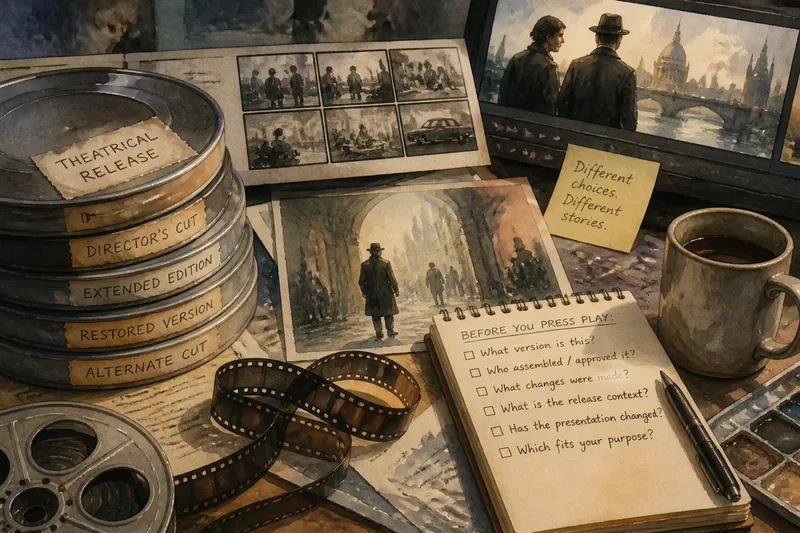
What should you check before pressing play?
- Read the exact version label. Decide whether it names a theatrical, extended, alternate, restored, or director-approved cut.
- Check who assembled or approved it. An edition note may identify the director, editor, studio, or restoration team.
- Look for a comparison of changes. Added scenes, a new ending, or reordered sequences can explain why the versions feel different.
- Notice the release context. A cinema release, television edit, and home edition may serve different audiences and conditions.
- Check whether the presentation itself changed. A new image or sound restoration may leave the edit intact while changing how it appears and sounds.
- Match the version to your purpose. Choose the first release for reception history, a clearly attributed revision for creative comparison, or the version specified for a shared discussion.
It is not worth treating every added scene as a clue to the film’s one hidden, correct meaning. Some material was cut for sound reasons, some was later reconsidered, and some survives because a new edition made it available. Extra footage gives you something to examine, not an automatic verdict.
What do viewers usually want to know about alternate cuts?
Is the director’s cut always longer?
No. A director’s cut can be longer, shorter, or simply different from the theatrical release. The label describes an edition’s relationship to the director, not a required running time.
Is the theatrical cut the original version?
It is generally the version released to cinemas, but a film may have had different releases across markets or changed during its run. For a specific title, the edition notes can clarify which release the label refers to.
Does “restored” mean scenes have been added?
Not necessarily. Restoration can improve the presentation of surviving material without changing the edit. Added or reassembled scenes should be described separately in the release information.
Which cut should a film club choose?
Choose the version that fits the conversation, then tell viewers which one they will see. A first-release cut suits a discussion of original reception, while an attributed alternate edit suits comparison of later creative choices.
Why can several versions belong to the same film?
Each cut records a different point in a film’s public life. One may show the form that reached theaters; another may reveal a director’s later revision; a restored edition may preserve the work of people who recovered or prepared its materials. These versions can illuminate one another without collapsing into a single definitive answer.
When you search for a film version, include the edition label alongside the title. That small habit helps you find the cut you actually mean and makes conversations more precise. The next time an edition promises the “complete” film, ask complete for which release, according to whose decisions, and for what kind of viewing.