How the Double Feature Turned Two Films Into One Night Out
The double feature reshaped American moviegoing by pairing films into a longer program, revealing how theater schedules, studio distribution, and audience habits worked together.
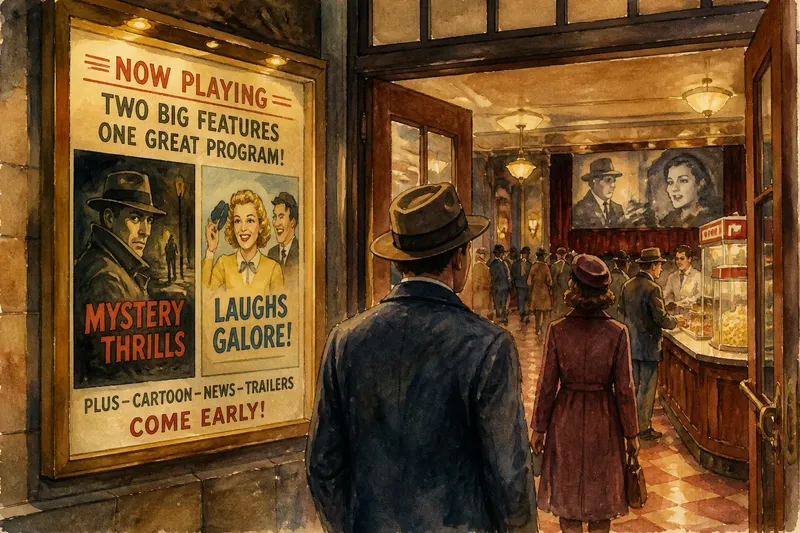
A patron entering a neighborhood theater during the studio era might find a feature film, a supporting picture, and short subjects listed as one program. The double feature made that kind of evening familiar in the United States, though theaters adopted it at different times and for different reasons. Its story belongs to exhibition as much as to the films themselves: the sequence on the screen shaped the experience of the night.
Why did theaters adopt the double feature?
The double feature became prominent in American theaters during the economic pressures of the 1930s. Exhibitors competed for patrons’ limited leisure spending, and a bill promising two feature films offered a clear inducement. But there was no single origin or switch that made the custom universal. Local theater owners, distributors, and changing booking arrangements all influenced how programs were assembled.
Studios and exhibitors also worked within a system that supplied films in different budget and prestige tiers. A prominent attraction could headline a bill, while a less costly supporting feature helped fill out the program. That pairing was a commercial arrangement, not necessarily a claim that the second film had no artistic value.
The promise of two stories could make a night at the cinema feel more substantial. It also gave a theater flexibility: a familiar draw might bring people in, while its companion offered another genre or a less familiar cast.
What made one film the main attraction?
A double bill generally had a hierarchy. The main feature received the strongest billing and was expected to do most of the work attracting patrons. The supporting feature completed the program and might contrast with the lead film in tone, genre, or scale.
“B picture” is related to this history, but it is not a perfect synonym for “second feature.” The term often referred to a production’s position or budget within studio-era filmmaking; a film’s place on a particular theater’s bill depended on how the exhibitor presented it. The distinction helps explain why the supporting picture should not automatically be treated as an inferior movie.
Imagine a theater advertising a suspense film alongside a brisk comedy. A viewer drawn by the mystery might stay for the comedy, while someone who came for the lighter film might arrive in time for the suspense story. The pairing gives the evening a broader appeal without requiring either film to satisfy every taste.
How did the bill shape the cinema visit?
Two features changed the rhythm of a visit. Patrons could spend much of an evening in the theater, moving from one story to another, often with short subjects or a break between them. The interval might give people time to stretch, talk in the lobby, or get refreshments.
Programs varied by venue and period. Some included newsreels, cartoons, trailers, or other short films, so the double feature was not always just two uninterrupted movies. The theater’s schedule and presentation shaped how the pictures met: one could set up a contrast, or leave viewers carrying a mood into the next film.
That longer format also asked more of an audience’s schedule. A family might decide that the first feature suited their evening but the full program would run too late for their plans. Someone meeting friends might need to settle on whether to arrive at the start or during the interval.
How did exhibitors build a strong pairing?
There was no universal formula for matching films. An exhibitor might place a comedy beside a crime story, pair films with overlapping audiences, or use a familiar attraction to draw attention to a lesser-known companion. The aim was to make the full program appealing, not necessarily to create a thematic argument between the pictures.
Timing mattered too. A bill had to fit the theater’s schedule, including the interval and any short subjects. Two films with similar moods could feel repetitive; a sharp contrast could refresh the program. Local tastes and the films available to a theater affected the choice, so a pairing that suited one neighborhood might not work as well elsewhere.
What is not worth the effort is treating every supporting picture as a forgotten masterpiece or assuming every audience watched both films with equal attention. A film’s position on the bill tells us how it was presented, not exactly how each patron judged it.
What did audiences gain, and what did they trade?
The most obvious appeal was getting two features in one visit. The second film could introduce a performer, genre, or style a patron might not have chosen alone. The arrangement also made the sequence matter: a comedy after a tense mystery could feel different from the same comedy shown first.
The trade-off was time and attention. A longer program could be inconvenient for patrons with other plans, and not everyone wanted to stay through the entire bill. Admission practices and schedules varied, so arriving late or leaving early depended on the theater. A two-film program offered more to see, but its full experience demanded a longer commitment.
Why did the double feature become less routine?
The shift away from double features was gradual, not a single event. Exhibition practices changed after the studio-era system of production, distribution, and theater ownership was reshaped. Television added a competing form of home entertainment, while changing release patterns and audience expectations encouraged many theaters to center programs on one principal feature. The balance differed across venues and over time.
Double bills did not disappear. Repertory cinemas, festivals, and special screenings still pair films, often to invite comparison or create a conversation between them. In those settings, the relationship between the two titles is usually the point, rather than a supporting picture simply completing a commercial program.
What do people ask about the double feature?
What was a double feature in movie theaters?
It was a program built around two feature films shown as part of one cinema visit. One usually received top billing, while the other completed the advertised bill.
Was the second film always a B movie?
No. “B picture” often described a supporting or lower-budget production, but “second feature” described a film’s position in a program. The terms can overlap without meaning precisely the same thing.
Did audiences have to stay for both films?
The films were advertised as a pair, but whether patrons could arrive late or leave early depended on the venue’s schedule and admission practices. Doing so meant missing part of the program.
Why do theaters still show double features?
Modern double bills often connect films through a shared theme, performer, genre, or contrast in style. Seeing them in sequence can change how viewers interpret each one.
The double feature is best understood as a change in the unit of moviegoing: the evening, not just the individual film. To understand a particular bill, look beyond its titles to the billing order, accompanying short subjects, and theater schedule. Those details show whether the pairing was chiefly a commercial offer or a carefully shaped encounter between films.